Design Patterns Notes
Table of Contents
- Design Patterns Notes
- Overview
- Fundamentals OOP
- Reference \& Classes
- UML Basics
- UML Diagrams
- Design Patterns history
- Design Patterns concept
- Design Patterns Organization
- Creationals patterns
- Structurals patterns
- Behaviorals patterns
- Design Patterns - Usage
- Identify the problem
- Find the pattern
- Apply the pattern
- Hello World!
- References
Overview
This is Design Patterns "Hello World" resources
Fundamentals OOP
- Encapsulation : data + procedures/functions
- Message : different from static binding (where is the compiler responsible for compilation + final link), in message passing the objects are responsible for executing the code themselves (internally) : methods and attributes (dynamic binding) in (execution time)
- Polymorphism : a caller(method/function/calls w/ the same) can create/replace any object in different way
- Inheritance : create an object from an existing one (parent) with the same propreties (attributs and methods)
- Abstraction : concept of hiding the internal implementation details and only focus on inputs and outputs (ex: a coffee machine ..)
Reference & Classes
- Variables : Attribute w/ a reference (memory adress) : a name, reference, object
- Types :
- Class : Var + methods for future instance
- Type a variable or a return type
-
Mold type ? : A factory
-
Interface : Abstract type (abstract class) w/ methodes signatures (prototypes) => In the class we implement one/many interfaces methods
UML Basics
Class Model :
--------------
| className   |
--------------
| Attributes  |
--------------
| Operation1()|
| Operation2()|
| Operation3()|
--------------
Inheritance
Abstract classes : If a class doesn't provide an implementation for any operation
-------------------
| AbstractClass    |
----------------------
| AbstractOperation()|
----------------------
Instance
--------------
|   Class     |
--------------
       ^
       |
       | <<instanceOf>>
       |
       |
--------------
|    Object   |
--------------
Relation between classes
- Dependency -----> (import; return values, params )
- Association/multiple associations : both instance objects are referenced
- Agregation : strong link
- Composition : STRONGEST link
UML Diagrams
Structural
- Class diagram
- Component diagram
- Composite structure diagram
- Deployment diagram
- Object diagram
- Package diagram
- Profile diagram
Behavioral :
- Activity diagram
- Communication diagram
- Interaction overview diagram
- Sequence diagram
- State diagram
- Timing diagram
- Use case diagram
Design Patterns history
Inspiration from architecture : by Christopher Alexander. Form the book, "A pattern language" (1977)
"FIRST" Software design patterns book : - "Design Patterns: Elements of Reusable Object-Oriented Software" (1995), by Erich Gamma, Richard Helm, Ralph Johnson and John Vlissides the Gang of Four (GoF).
Design Patterns concept
What is NOT a pattern : - a reusable or parametrizable componant - an algorithm. - a framework.
What is a pattern : - The identification by a name explicite who identify a the pattern - The description of the problem - The problem's solution - The positive and negative solution's concequencies
Design Patterns Organization
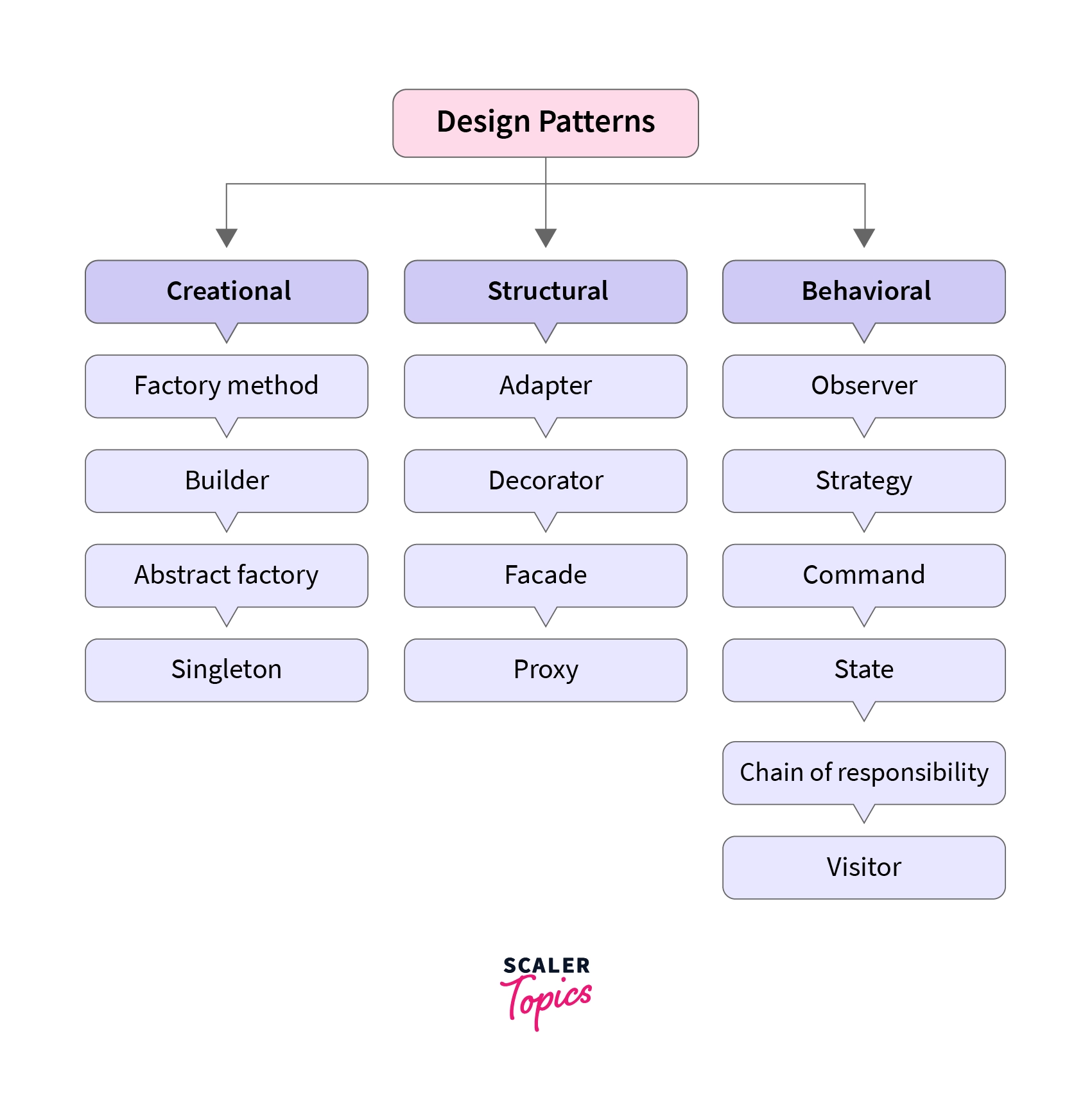
The 23 originals patterns referenced at the GoF's patterns are organized into 3 big families :
Creationals patterns
Abstract the instanciation process.
Singleton
Factory Method (*)
Manufactures an object
- case 1: Creator is an abstract (super)class
- case 2: Creator is an Concrete (super)class
-
case 3: Parameterized factory methods => create multiple products
-
Proprieties
- when creating an object without knowing it in davanced during the design stage (ex : an random event of same nature, decision (person class : teacher/student ) ...
- create new objects(products) during the run-time
- subclasses(creator) create the product instead of superclass(Creator)
-
subclasses(creator) overrides methods/operations of the superclasses(Creator)
-
Applications:
- create new objects(products) during the run-time
- useful for large projects
Abstract Factory
Builder
Prototype
Structurals patterns
Compose the objects and classes in large structures
- It uses inheritance to compose interfaces or implementations
Adapter (i.e. wrapper)
Interface convertor
- Proprieties *
- case 1 : create an adapter class?
-
case 2 : work through the adapter to convert the incomptible class to be used by the client ?
-
Applications :
- How can a class be reused that does not have an interface that a client requires?
- How can classes that have incompatible interfaces work together?
- How can an alternative interface be provided for a class?
- Gateway? API ?
Bridge
Composite
Decorator
Facade
Flyweight
Proxy
Behaviorals patterns
Assign responsiblities between the objects.
Interpreter
Template method
Chain of responsibility
Command
Iterator
Mediator
Define an object that encapsulates how a set of objects interact
- Proprieties *
- case1 : Mediator promotes loose coupling by keeping objects from referring to each other explicitly
- case2 : it lets you vary their interaction independently.
- Applications :
- ?
Memento
Observer
State
Strategy
Visitor
Design Patterns - Usage
- Find the problem
- Find the generic pattern for this problem
- Create his own solution by reusing the generic solution
Identify the problem
- understand well his conception problem /!\ get to know very all the patterns will much easier to identify the pattern that fits the best /!\
Find the pattern
-identify the pattern(s) -identify the paticipants -study the impact/consequence of its use
Apply the pattern
-Finally, to create our own solution by reusing the generic solution. -We match our participants and pattern's ones -we recreate the pattern schematic with our own names
/!\ Usage : rename the class WidgetGenerator => WidgetFactory (express more clearly the pattern used)
Hello World!
Refer to this repo.
References
Books: