Light - Notes
Table of Contents (ToC)
Introduction
Light is a form of electromagnetic radiation that is visible to the human eye and is responsible for the sense of sight.
What's Light?
- A type of electromagnetic radiation that travels in waves.
- Consists of photons, which are particles with no mass and travel at the speed of light.
- Fundamental to numerous natural and technological processes, including vision, photosynthesis, and communication.
Key Concepts and Terminology
- Wavelength: The distance between successive peaks of a wave, determining the color of light.
- Frequency: The number of waves that pass a point in one second, inversely related to wavelength.
- Photon: A particle representing a quantum of light.
- Refraction: The bending of light as it passes through different media.
- Reflection: The bouncing of light off a surface.
Applications
- Vision and optics, enabling sight and optical instruments.
- Photography and imaging technologies.
- Communication technologies, such as fiber optics.
- Solar energy and photosynthesis in plants.
- Spectroscopy for material analysis in science.
Fundamentals
Light Propagation and Behavior
- Speed of Light: Approximately 299,792 kilometers per second in a vacuum.
- Refraction: Light changes direction when it enters a different medium (e.g., from air to water).
- Reflection: Light bounces off surfaces, following the law of reflection (angle of incidence equals angle of reflection).
- Diffraction: Light bends around obstacles or through small openings, creating patterns of interference.
How Light Works?
- Electromagnetic Spectrum: Light is part of a broader spectrum of electromagnetic radiation, which includes radio waves, microwaves, infrared, ultraviolet, X-rays, and gamma rays.
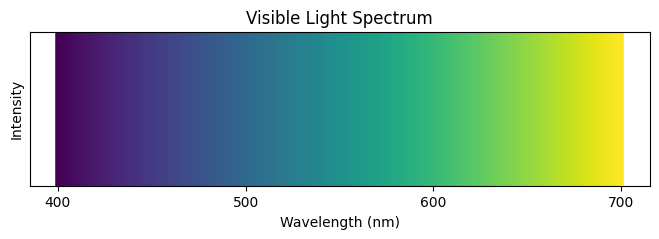
- Visible Spectrum: The range of wavelengths from approximately 400 to 700 nanometers that the human eye can perceive as different colors.
- Dual Nature: Light exhibits both wave-like and particle-like properties, as described by wave-particle duality.
- Interaction with Matter: Light can be absorbed, transmitted, or reflected by different materials, leading to phenomena such as transparency, color, and brightness.
Types of Light
- Natural Light:
- Emitted by the sun, stars, and other natural sources.
-
Essential for natural processes like photosynthesis and the circadian rhythm.
-
Artificial Light:
- Produced by man-made sources such as incandescent bulbs, LEDs, and lasers.
-
Used in lighting, displays, and various technologies.
-
Monochromatic Light:
- Light of a single wavelength, typically produced by lasers.
-
Used in precise scientific measurements and optical devices.
-
Polychromatic Light:
- Light that consists of multiple wavelengths, like white light from the sun or bulbs.
- Can be split into its component colors using a prism.
Some Hands-on Examples
- Experimenting with Refraction: Observing how light bends when passing through water.
- Prism Experiment: Splitting white light into its component colors using a glass prism.
- Measuring Light Intensity: Using a light meter to measure the intensity of natural vs. artificial light sources.
Tools & Frameworks
- Optical Simulation Software: Tools like OptiSystem and ZEMAX for designing optical systems and simulating light behavior.
- Spectroscopy Tools: Instruments for analyzing the spectral properties of light.
- Arduino and Light Sensors: For DIY projects involving light detection and measurement.
Hello World!
import matplotlib.pyplot as plt
import numpy as np

# Simulate the spectrum of visible light (wavelengths 400-700 nm)
wavelengths = np.linspace(400, 700, 300)
colors = plt.cm.viridis((wavelengths - 400) / (700 - 400))

# Create a plot of the visible spectrum
plt.figure(figsize=(8, 2))
for i, color in enumerate(colors):
    plt.axvline(x=wavelengths[i], color=color, linewidth=4)
plt.title("Visible Light Spectrum")
plt.xlabel("Wavelength (nm)")
plt.ylabel("Intensity")
plt.xticks([400, 500, 600, 700])
plt.yticks([])
plt.show()
output:
Lab: Zero to Hero Projects
- Building a simple spectroscope to observe the spectrum of different light sources.
- Creating a solar-powered light sensor to measure light intensity over time.
- Designing an optical communication system using LEDs and light sensors.
References
- Hecht, Eugene. Optics. (2002).
- Feynman, Richard P. QED: The Strange Theory of Light and Matter. (1985).
- Born, Max, and Emil Wolf. Principles of Optics: Electromagnetic Theory of Propagation, Interference and Diffraction of Light. (1999).
- Wikipedia: Light
- NASA's Science Mission Directorate: What is Light?