🤖 Artificial Intelligence (AI) - Notes
Table of Contents
- Introduction
- Key Concepts
- Applications
- AI Leading Companies
- AI Pipeline
- Description
- How Artificial Intelligence Works
- Methods, Types & Variations
- Framework / Key Theories or Models
- AI Evolution
- Classic AI (Weak / Narrow)
- Generative AI
- Artificial General Intelligence (AGI) - Strong AI
- Self-Practice / Hands-On Examples
- Pitfalls & Challenges
- Feedback & Evaluation
- Tools, Libraries & Frameworks
- Hello World! (Practical Example)
- Advanced Exploration
- Zero to Hero Lab Projects
- How to Build AI from Zero to Hero
- Continuous Learning Strategy
- References
Introduction
Artificial Intelligence (AI) refers to machines and systems that simulate human intelligence to perform tasks such as reasoning, learning, and problem-solving.
Key Concepts
- Narrow AI: AI systems designed to perform a specific task (e.g., speech recognition, recommendation systems).
- General AI: Hypothetical AI with the ability to understand and perform any intellectual task that a human can.
- Machine Learning (ML): A subset of AI where systems learn from data to improve their performance without explicit programming.
- Deep Learning (DL): A subset of ML that uses neural networks with many layers to model complex patterns in data.
- Common Misconception: AI is not always about robots—it’s a much broader field that includes natural language processing (NLP), decision-making, and more.
Applications
- Healthcare: AI is used for diagnosing diseases, personalized medicine, and drug discovery.
- Transportation: Autonomous vehicles rely on AI for real-time decision-making and navigation.
- Finance: AI powers fraud detection systems, algorithmic trading, and customer service chatbots.
- Education: AI enables personalized learning experiences through adaptive tutoring systems.
- Entertainment: AI drives recommendation systems on platforms like Netflix, YouTube, and Spotify.
- Robotics: General Purpose Humanoid Robots
- Games: strategic game systems (such as chess and Go).
- Advanced web search engines (Google, Bing..)
- Recommendation systems (used by YouTube, Amazon and Netflix)
- Understanding human speech (such as Siri and Alexa)
- Computer Vision: Image generation & synthesis ...
- ...
AI Pipeline
graph LR
    A[Data Collection] --> B[Preprocessing and Cleaning]
    B --> C[Algorithm Selection]
    C --> D[Model Training]
    D --> E[Decision Making / Output]
E --> F[Continuous Improvement]Description
- Data Collection: AI systems rely on vast amounts of data to learn.
- Preprocessing: Cleaning, organizing, and preparing the data for analysis.
- Algorithm Selection: Choosing the right algorithm (e.g., neural networks, decision trees) based on the task.
- Model Training: Teaching the AI system using historical data to recognize patterns and make predictions.
- Decision Making: AI models generate insights, decisions, or predictions based on new inputs.
- Continuous Improvement: AI systems learn and adapt from feedback or new data.
How Artificial Intelligence Works
- Step 1: Data is gathered, labeled, and preprocessed.
- Step 2: An AI algorithm (e.g., neural networks, decision trees) is selected based on the nature of the task (e.g., image recognition, NLP).
- Step 3: The algorithm is trained by feeding it data and adjusting parameters to reduce errors.
- Step 4: The trained model is deployed to make decisions or predictions based on new data.
- Step 5: The system continues learning from new inputs, feedback, and experiences to improve accuracy.
Methods, Types & Variations
- Rule-based AI: Early AI systems that rely on predefined rules for decision-making.
- Machine Learning: AI models that learn from data rather than being explicitly programmed.
- Deep Learning: AI models using deep neural networks to understand complex patterns in data.
- Reinforcement Learning: AI agents learn by interacting with environments and receiving rewards.
- Contrasting Example: Rule-based systems use fixed instructions, while machine learning models adapt and improve over time.
Framework / Key Theories or Models
- Turing Test: A measure of a machine's ability to exhibit intelligent behavior equivalent to or indistinguishable from a human.
- Neural Networks: Models that mimic the human brain to recognize patterns and solve problems in complex datasets.
- Reinforcement Learning: A model where agents learn through rewards and penalties in an environment (e.g., AlphaGo).
- Natural Language Processing (NLP): Enables machines to understand, interpret, and respond to human language (e.g., GPT models).
- Historical Framework: Early AI focused on rule-based systems, evolving into more data-driven approaches like machine learning and deep learning.
AI Evolution
I predicted the future of AI in 2016: Research Work - Strong AI (2016)
Classic AI (Weak / Narrow):
Able to analyse large amounts of data, which can be used, for example, to predict what content people will find more relevant or valuable.
Generative AI:
Generative Differeciate through its ability to create new content using text, audio, images or videos, which it can transfer into essays, songs, tunes, artwork, film, or advertising.
- Related Notes: GenAI
Artificial General Intelligence (AGI) - Strong AI:
Cognitive functions (like reasoning, planning and perception) that bring us to human capabilities and beyond.
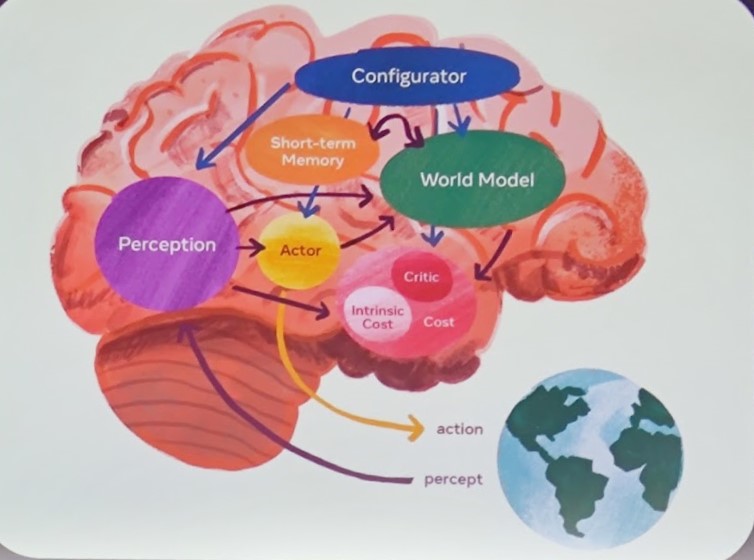
Src: from Christian Keller (@Meta) workshop @ai-PULSE 2024.
Related notes: - AGI notes - @OpenAI Planning for AGI and beyond - @DeepMind AGI - @DeepMind Vision on AGI - Richard Feynman on Artificial General Intelligence
Autonomous (AI) Agents
AI Agent
- Related notes: AI Agents
Embodied-AI Agents
- Related notes: Embodied-AI Agents
Some Embodied-AI for General-Purpose-Humanoid-Robots:
- 1X: NEO
- Figure: 01,
- Tesla: Optimus,
- SanctuaryAI: Phoenix,
- BostonDynamics: Atlas.
Some Embodied-AI for Autonomous Vehicles
Embodied AI Workshop - CVPR 2023: - embodied-ai.org
AI Leading Companies
- OpenAI
- DeepMind
- MS
- Meta
- NVIDIA
- AMD
- Intel
- ...
Self-Practice / Hands-On Examples
- Create a chatbot using natural language processing libraries like NLTK or spaCy.
- Build an image classifier using TensorFlow or PyTorch to classify images from a dataset (e.g., CIFAR-10).
- Train a reinforcement learning agent in OpenAI Gym to play a simple game like CartPole.
- Develop a recommendation system using collaborative filtering on user data (e.g., movie recommendations).
- Explore AI ethics by analyzing the biases in different AI models and algorithms.
Pitfalls & Challenges
- Data Quality: AI models are only as good as the data they’re trained on; poor-quality data leads to inaccurate predictions.
- Bias: AI models can inherit biases from their training data, leading to unfair or discriminatory outcomes.
- Interpretability: Complex AI models, especially deep learning, can be difficult to interpret or explain.
- Suggestion: Use explainable AI techniques and ensure diverse and balanced training datasets to reduce bias.
Tools, Libraries & Frameworks
- TensorFlow: An open-source platform for machine learning and deep learning.
- PyTorch: A deep learning framework popular for research and experimentation.
- Keras: A high-level API for building and training deep learning models, built on top of TensorFlow.
- OpenAI Gym: A toolkit for developing and comparing reinforcement learning algorithms.
- Pros & Cons: TensorFlow is highly scalable but has a steep learning curve; PyTorch is more user-friendly for experimentation but may not scale as well in production.
Hello World! (Practical Example)
This code defines a simple feedforward neural network using TensorFlow and Keras to classify images (e.g., MNIST dataset).
import tensorflow as tf
from tensorflow.keras.models import Sequential
from tensorflow.keras.layers import Dense

# Create a simple neural network model
model = Sequential()
model.add(Dense(32, input_shape=(784,), activation='relu'))
model.add(Dense(10, activation='softmax'))

# Compile the model
model.compile(optimizer='adam', loss='categorical_crossentropy', metrics=['accuracy'])

# Summary of the model
model.summary()
Feedback & Evaluation
- Feynman Test: Explain how neural networks work to a beginner using simple, non-technical language.
- Peer Review: Share your AI model results with a colleague for feedback on potential biases or performance issues.
- Real-world Simulation: Test your AI model in a simulated environment (e.g., a chatbot interacting with live users).
Advanced Exploration
- Research Paper: "Playing Atari with Deep Reinforcement Learning" – explores how deep learning can be combined with reinforcement learning.
- Video: "Artificial Intelligence and the Future" by MIT – a lecture on the broader impacts of AI on society.
- Article: "Explainable AI: Interpreting and Explaining Black-Box Models" – a deep dive into techniques for understanding AI decision-making.
Zero to Hero Lab Projects
- Beginner: Build a simple spam filter using logistic regression to classify emails as spam or not spam.
- Intermediate: Develop a face recognition system using deep learning and OpenCV.
- Advanced: Create a reinforcement learning agent that learns to solve complex environments in OpenAI Gym (e.g., robotic tasks).
- Build Artificial Intelligence from A to Z using reinforcement learning
Continuous Learning Strategy
- Explore ethics in AI to understand the social implications of AI technologies.
- Study transfer learning to leverage pre-trained models for your own tasks.
- Dive into natural language processing (NLP) and learn how AI models like GPT-4 generate human-like text.
References
Wikipedia resources: - What's AI ? - Category - path finding - odemetry - Turing machine
Cognitive Science Tree Wikipedia: - https://en.wikipedia.org/wiki/Cognitive_science - https://en.wikipedia.org/wiki/Artificial_intelligence - https://en.wikipedia.org/wiki/Cognitive_psychology#Neisser - https://en.wikipedia.org/wiki/Philosophy - https://en.wikipedia.org/wiki/Linguistics - https://en.wikipedia.org/wiki/Anthropology - https://en.wikipedia.org/wiki/Neuroscience
Neural Nets: - https://en.wikipedia.org/wiki/Brain - https://en.wikipedia.org/wiki/Neuron - https://en.wikipedia.org/wiki/Machine_learning - https://en.wikipedia.org/wiki/Deep_learning - https://en.wikipedia.org/wiki/Neural_network
Maths: - Stochastic process - Quantum computing
Research Notes: - Machine Learning - Neural Network - NLP - Computer Vision - robotics
Projects: - https://github.com/afondiel/my-lab/tree/master/projects/ai - https://github.com/afondiel/my-lab/tree/master/projects
Games: - https://en.wikipedia.org/wiki/Chess - https://en.wikipedia.org/wiki/Go_(game) - https://en.wikipedia.org/wiki/Xiangqi - ayo-olopon : https://scorum.com/en-us/other/@jotmax/ayo-olopon-the-game-of-the-intellectual-an-african-board-game
Mythology: - https://en.wikipedia.org/wiki/Egyptian_mythology - https://en.wikipedia.org/wiki/Roman_mythology
Lectures & Tutorial & Online Free Courses:
- UC Berkeley - CS188 Intro to AI -- Course Materials
-
Stanford CS221 - Overview Artificial Intelligence Course | Stanford CS221: Learn AI (Autumn 2019)
Great AI Blog: Jürgen Schmidhuber's AI Blog
-
Online Courses:
-
Code Spaces: https://www.codespaces.com/best-artificial-intelligence-courses-certifications.html
-
Geektonight: https://www.geektonight.com/best-artificial-intelligence-courses/
- Javin Paul medium article : https://medium.com/javarevisited/10-best-coursera-certifications-courses-for-machine-learning-and-artificial-intelligence-256d9a125822
-
My research on strong AI (AGI) survey from 1st grade of engineering degree @ ENSEA - 2016: - Strong AI (AGI) survey - ENSEA 2016
Books: - FREE AI BOOKs
Papers: - Research Papers - "Mastering Chess and Shogi by Self-Play with a General Reinforcement Learning Algorithm" by DeepMind (AlphaZero paper).