Markov Decision Process(MDP) - notes
Introduction
A MDP is a mathematical model used to make decisions in situations where outcomes are partly random and partly under the control of a decision maker ( Ex: An Agent ).
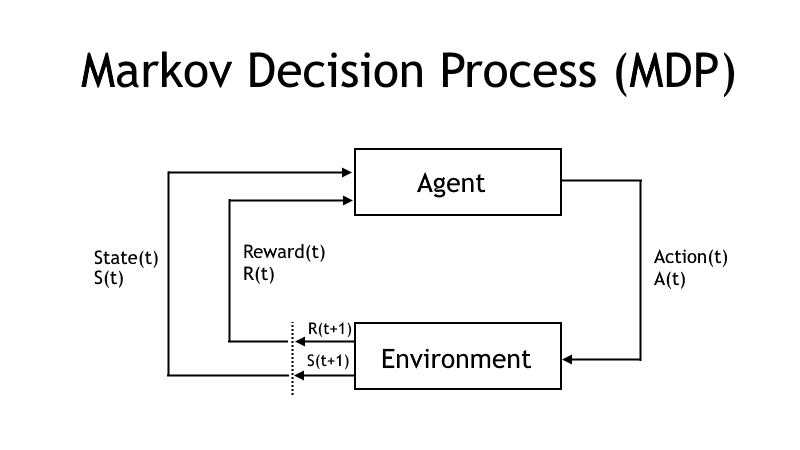
The MDP Model
Agent: observes a state, S(t), from the environment at time t and interacts with the environment by taking an action A(t).Environment: transitions to a new state S(t+1), at time t+1 based on action taken by the Agent and producing a next/future Reward while being on the current stateState - S(t): sets of state (S(t) : present state, S(t+1) : next state)Action - A(t): This action causes the Environment to transition to a new stateS(t+1)Reward - R(t): an scalar value sent by the environment, +1 : success and -1 : penality and R(t+1) : next reward)Transition funtion - T[s,a,s']: environment conditions to go the next statePolicy function - Pi(s): strategy used by the Agent to compute/judge the next 'best' Action to be taken A(t+1) that produces a better reward- The policy maps a given state
s, to a particular actionA(t): A(t) = Pi(s) Optimal Policy function - Pi*(s): the policy that maximizes the expected reward received from the environment over a long period of time
The MDP Proprieties
- “Markov” generally means that given the present state, the future and the past are independent
- For Markov decision processes, “Markov” means action outcomes depend only on the current state
- MDPs are non-deterministic search problems
- One way to solve them is with expectimax search
- We’ll have a new tool soon
Application
- Artificial Intelligence
- Reinforcement Learning
- Robotics
Tools/Framework
- Probabilities / statistics