Deep Learning (DL) - Notes
Table of Contents
- Overview
- Introduction
- Fundamentals
- Deep Learning Architecture Pipeline
- How Deep Learning works?
- Some hands-on examples
- What's Artificial Neural Networks (Neural Nets)?
- Biological Neuron vs Artificial Neuron
- The perceptron (A Linear Unit)
- Deep Neural Nets
- Popular Deep Learning Models \& Algorithms
- Model Evaluation
- DL Model Fine-tuning
- Tools \& Frameworks
- Hello World!
- Lab: Zero to Hero Projects
- References
Overview
Deep learning is a machine learning subset based on artificial neural networks that performs sophisticated computations on large amounts of data.
Introduction
Deep learning is a subset of machine learning that utilizes neural networks with multiple layers to model and understand complex patterns in data.
What's Deep Learning?
- A branch of machine learning focused on neural networks.
- Employs layers of algorithms to interpret data.
- Mimics human brain structure for pattern recognition.
Key Concepts and Terminology
- Neural Networks: The foundational structure consisting of layers.
- Layers: Different levels in a neural network, such as input, hidden, and output layers.
- Activation Functions: Functions that determine the output of a neural network node.
- Backpropagation: The process used to train neural networks.
Applications
- Image and speech recognition.
- Natural language processing.
- Autonomous vehicles.
- Healthcare diagnostics.
- Computer vision
- Object detection
- NLP
- Virtual assistant
- Face recognition
- Chatbots
- Sound addition to silent films
- Colorization of black and white images ... ...
- eveywhere since data is everywhere in modern world and taking part of daily life ...
Fundamentals
Deep Learning Architecture Pipeline
graph LR;
    A(Data Collection)-->B(Model training);
    B-->C(Model Evaluation and iteration);
    C-->D(Deployment)
    D-->E(Monitoring)
E-->A;How Deep Learning works?
- Data is fed into the input layer.
- The data is processed through hidden layers using weights and biases.
- Activation functions determine the output at each node.
- Output layer produces the final prediction or classification.
- Backpropagation adjusts weights to minimize error.
Some hands-on examples
- Building a simple neural network for image classification.
- Implementing a speech recognition model.
- Developing a text classification system using recurrent neural networks (RNNs).
What's Artificial Neural Networks (Neural Nets)?
Neural Nets (NN) are a stack of algorithms that simulates the way humans learn. Neural Nets are composed of artificial neurons inspired biological neuron.
  graph LR;
    A(synapse of previous neuron)-->B(dendrites);
    B-->C((cell body));
    C-->D(axon);
    D-->E(synapse of current neuron);
    style A fill:#fff,stroke:#f66,stroke-width:2px,stroke-dasharray: 5, 5;
Biological Neuron vs Artificial Neuron
| Neuron | Perceptron |
|---|---|
| electrical signals | data samples |
| synapse(node) | input node(x, w, b) |
| dendrite | summation |
| cell-body(soma) | activation |
| axon | output node |
*New connexion : axon + synapse => next dendrite
The perceptron (A Linear Unit)
- The perceptron: first model invented by Mc Culloch-Pitts
- 1 input layer: x1, x2, ... ,xn
- Neuron:
x1*w1 + x2*w2 ... + b- Summation function
- Activation function (step: 0/1)
- 1 output layer
Where: x: input signals, b: bias, w: weights
Deep Neural Nets
- The Multilayer Perceptron (MLP) forms fully connected Neural Nets
- 1 input layer
- Multiple hidden layers
- Neuron
- Summation function
- Activation functions (step, tanh, sigmoid, RELU...)
- 1 output layer
Popular Deep Learning Models & Algorithms
- Perceptron = biological neuron
- Deep Neural Network
- MNIST Image Recognition
- Recurrent Neural Network (RNN)
- Transformers Family
- BERTs
- GPTs
- T5 ...
- Convolution Neural Network (CNN): vision tasks
- Long Short Term Memory Networks (LSTMs): audio/speech tasks
- Recurrent Neural Networks (RNNs)
- Generative Adversarial Networks (GANs)
- Radial Basis Function Networks (RBFNs)
- Multilayer Perceptrons (MLPs)
- Self Organizing Maps (SOMs)
- Deep Belief Networks (DBNs)
- Restricted Boltzmann Machines(RBMs)
For full list and description, please checkout the Neural Networks architecture notes.
Problem Definition
WHAT? (the problem) - A "loss function" that measures how good the network's predictions are.
HOW? (to solve it) - An "optimizer" that can tell the network how to change its weights.
Data collection
Dataset:
- Dataset is split into:
- Training set: new dataset (generalization)
- Validation set: evaluate the performance of the model based on diffrent
- Test set: final evaluation
Training Process - Error/cost function: - R^2
-
Backpropagation: allows NeuralNet figure out patterns that are convoluted(complex) for human to extract
-
Optimizer functions:
-
gradient descent ...
-
Prediction
- Activation function:
- Heaveside
- Sigmoid
- SoftMAx
- Tanh
- relu
- GLU
- SwiGLU
More: https://deepgram.com/ai-glossary/activation-functions
Model Tuning/Configuration
Hyperparameters: are used to control the behavior of the learning algorithm
- Learning Rate (LR): the speed the model learning
- Epoch: when the model is trained on the entire dataset (forward + backpropagation)
- Batch size: process of splitting the dataset into small chuncks
- iteration: number of batch size in entire dataset
We can configure the the capacity (complexity) of the model by tuning its hyperparameters - learning rate - number of layers - numbers of hidden layers - the depth of NeuralNet
Model Evaluation
Evaluation:
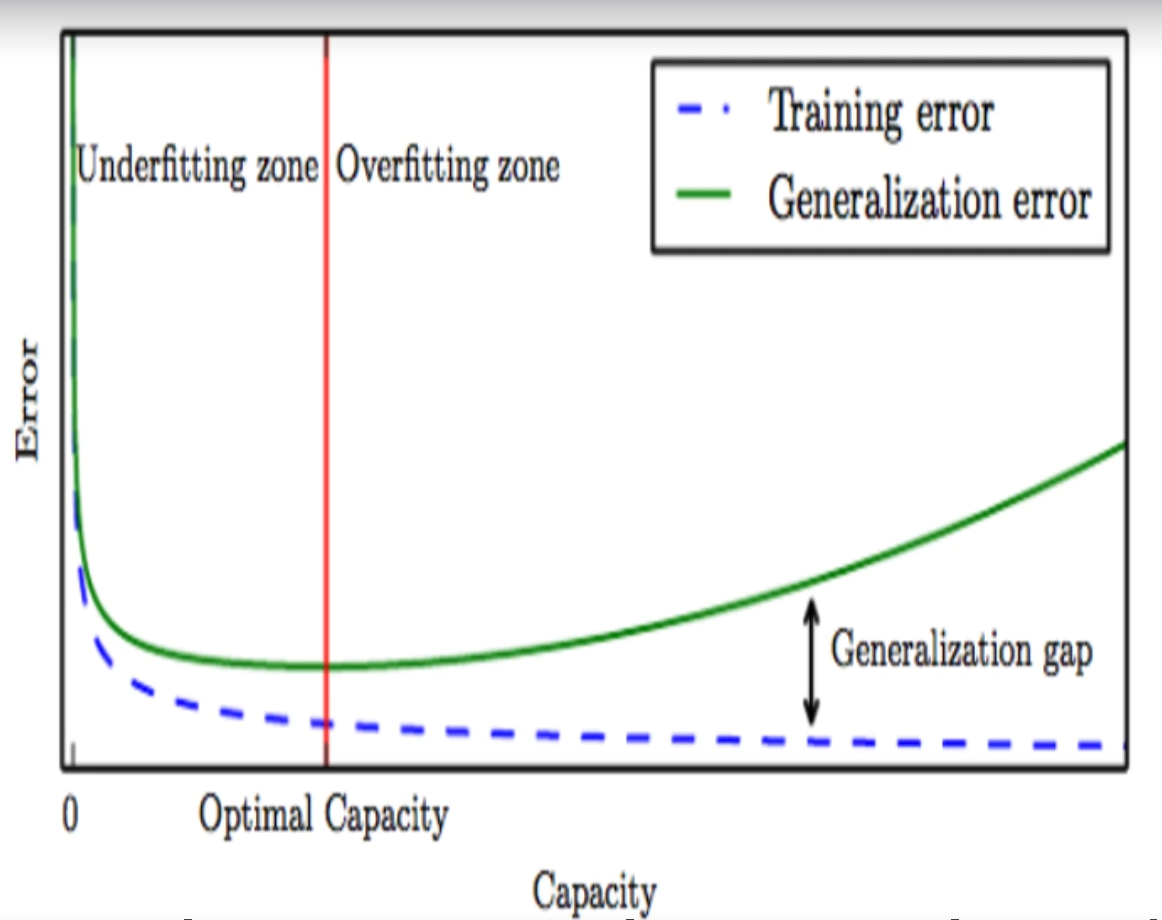
Condition of good model: test error > train error
- underfitting: simple model or low capacity with larger dataset leading to poor performance
- overfitting: complex model or high capacity with smaller dataset leading to poor generalization
| Underfitting | Overfitting | |
|---|---|---|
| Bias | high | low |
| Variance ( $\sigma^2$ ) | low | high |
| Train data | bad | good |
| Unseen data | bad | bad |
| Accuracy | train + val/test: Bad | train: OK , Val/test: NOK |
| Cause | less data | noisy data |
| Solution | more data can't help | more data can help |
Error vs Capacity - capacity: the complexity of the model - the deeper the NeuralNet the higher the capacity to learn - error: ? - train error:? - test error: - Generalization gap: the gap btw train error and test error - Bias - Variance - Early Stopping (optimal solution) - it's not bad if the accuracy ok (train + test) => bias + variance: ok - Otherwise Regularization is the way to go!!!
Error vs Accuracy - Error - training - test - Prediction: - y_pred = model.pred(X_train or X_test) - Accuracy: - Sum(Corrected pred)/all_predition
import numpy as np

# Assuming you have a trained model, training data (X_train, y_train), and test data (X_test, y_test)

# Prediction on the training set
y_pred_train = model.predict(X_train)

# Prediction on the test set
y_pred_test = model.predict(X_test)

# Accuracy on the training set
accuracy_train = np.mean(y_pred_train == y_train)

# Accuracy on the test set
accuracy_test = np.mean(y_pred_test == y_test)
DL Model Fine-tuning
- Check the Fine-tuning section of Neural Nets Hacker Notes.
Tools & Frameworks
Hello World!
A simple "Hello World" deep learning program that trains a basic neural network on the classic MNIST dataset of handwritten digits.
PyTorch Version:
import torch
import torch.nn as nn
import torch.optim as optim
from torchvision import datasets, transforms

# Define the network architecture
class SimpleNN(nn.Module):
    def __init__(self):
        super(SimpleNN, self).__init__()
        self.fc1 = nn.Linear(28 * 28, 128)
        self.fc2 = nn.Linear(128, 10)

    def forward(self, x):
        x = x.view(-1, 28 * 28)  # Flatten the image
        x = torch.relu(self.fc1(x))
        x = self.fc2(x)
        return x

# Training function
def train(model, device, train_loader, optimizer, criterion, epoch):
    model.train()
    for batch_idx, (data, target) in enumerate(train_loader):
        data, target = data.to(device), target.to(device)
        optimizer.zero_grad()
        output = model(data)
        loss = criterion(output, target)
        loss.backward()
        optimizer.step()
        if batch_idx % 100 == 0:
            print(f'Train Epoch: {epoch} [{batch_idx * len(data)}/{len(train_loader.dataset)}]\tLoss: {loss.item():.6f}')

# Set up training
device = torch.device("cuda" if torch.cuda.is_available() else "cpu")
train_loader = torch.utils.data.DataLoader(datasets.MNIST('./data', train=True, download=True,
                                                          transform=transforms.ToTensor()),
                                           batch_size=64, shuffle=True)

model = SimpleNN().to(device)
optimizer = optim.Adam(model.parameters(), lr=0.001)
criterion = nn.CrossEntropyLoss()

# Train for one epoch
for epoch in range(1, 2):
    train(model, device, train_loader, optimizer, criterion, epoch)
TensorFlow Version:
import tensorflow as tf
from tensorflow.keras import layers, models
from tensorflow.keras.datasets import mnist

# Load and preprocess data
(x_train, y_train), (_, _) = mnist.load_data()
x_train = x_train.reshape(-1, 28 * 28).astype('float32') / 255
y_train = tf.keras.utils.to_categorical(y_train, 10)

# Define the network architecture
model = models.Sequential([
    layers.Dense(128, activation='relu', input_shape=(28 * 28,)),
    layers.Dense(10, activation='softmax')
])

# Compile the model
model.compile(optimizer='adam', loss='categorical_crossentropy', metrics=['accuracy'])

# Train the model
model.fit(x_train, y_train, epochs=1, batch_size=64, verbose=1)

# Prediction function
def predict(model, x_test, y_test):
    predictions = model.predict(x_test[:10])  # Get predictions for the first 10 samples
    for i, pred in enumerate(predictions):
        predicted_label = np.argmax(pred)
        true_label = np.argmax(y_test[i])
        print(f'Predicted: {predicted_label}, True Label: {true_label}')

# Make predictions on test data
predict(model, x_test, y_test)
Explanation:
- Model: Both versions create a simple neural network with two fully connected layers.
- The first layer has 128 neurons and uses ReLU activation.
- The second layer has 10 neurons (for 10 classes in MNIST) and uses softmax activation.
- Dataset: The MNIST dataset is used in both cases.
- Training: Both codes train the network for one epoch. You can easily extend it for more epochs.
- Prediction: After training,
model.predict()is used to predict classes for a subset of test images (first 10). The predicted class is obtained withnp.argmax(), which returns the index of the highest softmax probability.
Explaination in Depth: But what is a neural network? | Chapter 1, Deep learning - 3Blue1Brown
Lab: Zero to Hero Projects
- Project 1: Image Classification with Convolutional Neural Networks (CNNs).
- Project 2: Sentiment Analysis using Long Short-Term Memory networks (LSTMs).
- Project 3: Developing a Chatbot with Deep Learning techniques.
- Project 4: Time Series Forecasting with Recurrent Neural Networks (RNNs).
References
Types of Machine Learning: - Supervised Learning - Semi-supervised Learning - Unsupervised Learning - Reinforcement Learning
Lectures & Tutorials:
- Neural Network Playlist - 3Blue1Brown
- Deep Learning School - Sept 24/25 2016, Lex Frimad
- karpathy.ai:
- Neural Networks: Zero to Hero - karpathy.ai
- Hacker's guide to Neural Networks - karpathy.ai
- FreebootCamp:
- Deep Learning Crash Course for Beginners - FreebootCamp
- NVIDIA:
- NVIDIA Deep Learning Institute
- Learn to use Deep Learning, Computer Vision and Machine Learning techniques to Build an Autonomous Car with Python
Forums & Discussions: - Neural Networks: Zero to Hero - YC News
Research Paper/Works - Goodfellow, I., Bengio, Y., & Courville, A. (2016). Deep Learning. MIT Press. - LeCun, Y., Bengio, Y., & Hinton, G. (2015). Deep learning. Nature, 521(7553), 436-444. - Chollet, F. (2017). Deep Learning with Python. Manning Publications.