Machine Learning (ML) - Notes
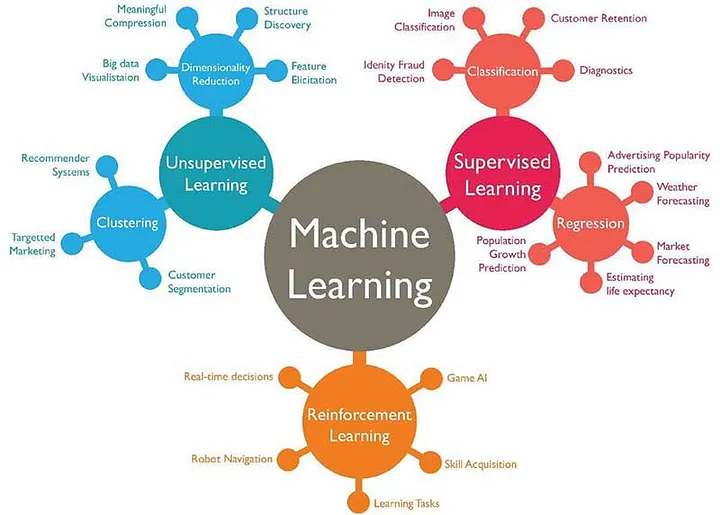
Src : towardsdatascience - Hunter Heidenreich
Agenda
- Agenda
- Intro
- ML vs Traditional coding
- Training the Model (CLassifier)
- ML algorithms
- ML Frameworks/tools
- ML Problem solving in 7 steps
- References
Intro
ML is a field of AI algorithms that learn from EXAMPLES and EXPERIENCES instead of traditional HARDCODE and RULES
Ex : Apple and oranges detection
ML vs Traditional coding
- Tradictional coding : too much rules
-
ML : Model / Classifier and train it to generate the RULES instead of writing them
-
classifier (as function) : takes a data as input (FEATURES) and signs LABEL to it as output(LABELS)
- Fruit(apple or orange?) => Classifier => apple (if apple chose)
- email (spam/mail_ok) => Classifier => spam (if mail_nok)
Training the Model (CLassifier)
To Train the Classifier we use :
- Supervised Learning(SL) : it learns from examples/experiences
- Unsuspervised Learning(USL) : it learns from events ?
- Reinforcement Learning (RL): Conceptually similar to human learning processes
- ex: a robot learning to walk
- Strategy games : Go, Chess etc
The more the training data exists => the better the classifier Will be
ML train
|--------|          |-----------|       |-----------|
|Collect |          |Train      |       |Make       |
|Training|    =>    |Classifier |   =>  |Predictions|
|   Data |          |           |       |           |
|--------|          |-----------|       |-----------|
ML algorithms
Supervised:- Regression : Predicting a continuous-valued attribute associated with an object
- Multiple Linear Regression(MLR)
- Polynomial Regression (PR)
-
Classification : Identifying which category an object belongs to
- k-Nearest Neighbor
- Decision Trees(ID3, C4.5, C5.0)
- logistic regression
- Naïve Bayes
- Linear Discriminant Analysis
- Neural Networks
- Support Vector Machines (SVM)
- Random Forest(RF)
-
Unsupervised:- Clustering : Automatic grouping of similar objects into sets.
- k-Means
- Mean-shift
- Hierarchical Clustering (HC)
- Density-based Clustering (DBSCAN)
- Gaussian Mixture Models(GMM)
- Clustering : Automatic grouping of similar objects into sets.
Reinforcement:- Q-Learning
- Deep Q-Network (DQN)
- A3C
ML Frameworks/tools
- TensorFlow
- PyTorch
- Scikit-learn
- Spark ML
- Torch
- Huggingface
- Keras
ML Problem solving in 7 steps
- GATHERING / COLLECTING DATA : The more data we collect the more accurate will the model.
-
We collect datas to train the model of the system we want to deploy
-
DATA PREPARATION :
- Features ? : the input of the system
- Labels ? : the output of the system
- visualization of datas
- balances, relationship between datas
- split : training/evaluation(performance of the model)
-
Choosing the MODEL : There are already alot of model created by DataScientists :
- For : Music, image, number, text, text based data, linear model (y=ax+b)
-
TRAINING (the model : Y = mx+b) :
- Y : output
- m : SLope (many m possible, as many features)
- X : input
- b : Y-intercept Training process
Each iteration it's called, a training steps.
/!\ #Residus = Biais ( θ ^ ) ≡ E [ θ ^ ] − θ #Définition — Si θ ^ est l'estimateur de θ
- EVALUATION : after the model is good time to evaluate
        |----------|         |-----------|       |------------|
        |          |         |   Model   |       |            |
        |EVALUATION|  =>     |   (W,b)   |  =>   | Prediction |
        |   Data   |         |           |       |            |
        |----------|         |-----------|       |------------|

                            |-----------|           ||
            /\              |           |           \/
            ||      <=      |Test       |   <=
                            | (W,b)     |
                            |-----------|
This metric allows the model to see the data that has not yet seen. This is to test how the model might act in the real world
-
PARAMETER TUNING
- To improve the training
- Repeat the training data several time to increase the accuracy
- Learning rate : limit of the train / how far we shift the line between two input datas
- initial conditions : for complexes models (value = 0 ...)
- Hyperparameters.
/!\ : it's important to choose the good parameters to be changed
- PREDICTIONS : ML uses datas to answer questions
Input : features Output : Labels
References
Scikit learn : https://scikit-learn.org/stable/#
TensorFlow : https://www.tensorflow.org/resources/learn-ml
Spark ML : https://spark.apache.org/docs/latest/ml-guide.html
PyTorch : https://pytorch.org/tutorials/beginner/deep_learning_60min_blitz.html https://docs.microsoft.com/en-us/learn/paths/pytorch-fundamentals/
Google course/ Josh gordon : https://www.youtube.com/watch?v=cKxRvEZd3Mw&list=PLOU2XLYxmsIIuiBfYad6rFYQU_jL2ryal
Google Cloud Plateform / Yufeng Guo: https://www.youtube.com/watch?v=nKW8Ndu7Mjw
IBM Cloud : https://www.ibm.com/cloud/blog/supervised-vs-unsupervised-learning