Reinforcement learning (RL) - notes  

Agenda
- Intro
- RL characteristics
- Applications - RL
- Tools / frameworks
- A simple RL is modeled by Markov Decision Process (MDP)
- The limit of Q-learning
- Models/Algorithms
- Implementation
- References
Intro
A machine learning approach/paradigm which enables a model to learning patterns from data with/without labels based on reward (if the model correctly learns a pattern) or a penalty otherwise.
RL characteristics
- No supervision, only reward signal
- Feedback can be delayed, non instantaneous
- Time matters
- Earlier decisions affect later interactions
Applications - RL
- Robotics
- Self-driving cars
- Strategy games : chess/Go/FrozenLake/Atari ...
Tools & Frameworks
- OpenAI Gym
- DeepMind Lab
- TensorFlow
- Keras
- Pytorch
- Markov Chain/Markov Decision Process (MDP)
A simple RL is modeled by Markov Decision Process (MDP)

Src : perfectial.com/rl-applications
RL provides a statistical framework based on two components :
- Agent(a) : takes actions that changes an existing state(S) of the environment
- Environment (b) : transites to a new/future state based on changes taken by the agent and provides feedback to the agent
- feedback : can either be positive(+) or negative(-), after set of feedbacks or iterations the agent tries to learn and optimize the future actions in order to get a maxime of (+) feedbacks => reward (function)
- Quality/Q-function : a given action that produces a future reward based on current state
Q-function : uses Bellman equation Q(s,a)
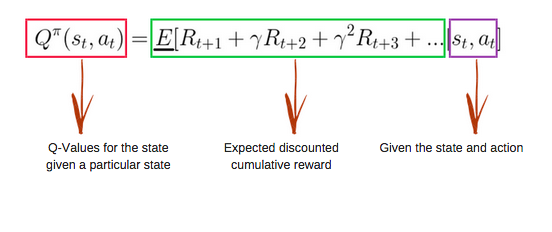
Q-funtion/Q-Learning strategy : 1. Value-based RL : Optimizes the maximum value function for a given action-state pair 2. Policy search-based RL : search for an optimal policy that's able to ach ieve a maximum future reward 3. Actor-critic-based RL: hybrid strategy which combines value-based + policy-based to solve RL learning problems
The limit of Q-learning
- Curse of dimensionality : when dealing with a large number of samples
- Sample correlation : successive samples are often correlated whe it comes to online updates.
Solution : deep reinforcement learning (DRL)
DRL : increases performance of model and solves Curse fo dimensionality and Sample Correlation.
Model Deep Q-Network (DQN) :
graph TD;
    CNN-->Q-value1;
    CNN-->Q-value2;
    CNN-->Q-value3;
    State-->CNN;
Deep Q-Network (DQN) high level architecture
| Layer | Input Size | Filter Size | Number of Filter | Stride Length | Activation Unit | Output Size |
|---|---|---|---|---|---|---|
| Conv-1 | 84x84x4 | 8x8 | 32 | 4 | Rectified Linear | 20 x 20 x 32 |
| Conv-2 | 20x20x32 | 4x4 | 64 | 2 | Rectified Linear | 9 x 9 x 64 |
| Conv-3 | 9x9x64 | 3x3 | 64 | 1 | Rectified Linear | 7 x 7 x 64 |
| fc4 | 7x7x64 | N/A | 512 | N/A | Rectified Linear | 512 |
| fc5 | 512 | N/A | 18 | N/A | Linear | 18 |
Where CNN has: - 3 cnn layers - 2 fcs (fully connected layers)
Convolution Neural Network(CNN) - DQN solves curse dimensionality but not the unstable learning issues due to high correlation in the input sequence data.
Ex: In case of Atari Games supporting iteractive actions coming from Joysticks
DQN Techniques :
- Experience replay : stores past experience in memory and use these samples during the learning stage or every time step t (iteration) to reduce correlation of sequence of data and avoiding overffiting
- Target network : fixes the parameter of the target function Q(s,a, tetat)
- reward clipping : allows to normalize the rewards, if they are not in the same scale
DQN approaches/Process
- Single-DQN : Recursive target Q(s,a, tetat) => Overestimate the values, can be costful if working with large sample => accumulate lots of errors!!!
- Double-DQN : to avoid the previous approach we divide the Q(s,a, tetat) into 2 functions : Q1 and Q2.
- Dueling-DQN : splits Q(s,a ) = V(s) + A(a) => for robustness modeling
Models/Algorithms

Source : OpenAI - A non-exhaustive, but useful taxonomy of algorithms in modern RL
Implementation
List of a NON-exaustive RL algorithms : - Notes - Implementations - RL application for self-driving cars
References
- DeepMind - course by Hado Van Hasselt - 2018
- Deep Learning Essentials - Wei Di, Anurag Bhardwaj, Jianing Wei
- Welcome to Spinning Up in Deep RL
- Reinforcement learning wiki
- Markov Chain
- MDP
- Stochastic Model
- Proba Theory
- Bellman equation
- Sequential logic
- Finite-state machine
- Dynamical_system
- implementing the a3c algorithm
- for a high dimensinal environment a Deep Reinforcement Learning is required
"It is difficult to free fools from the chains they revere." ~ Voltaire