Convolutional Neural Network (CNN) - Notes
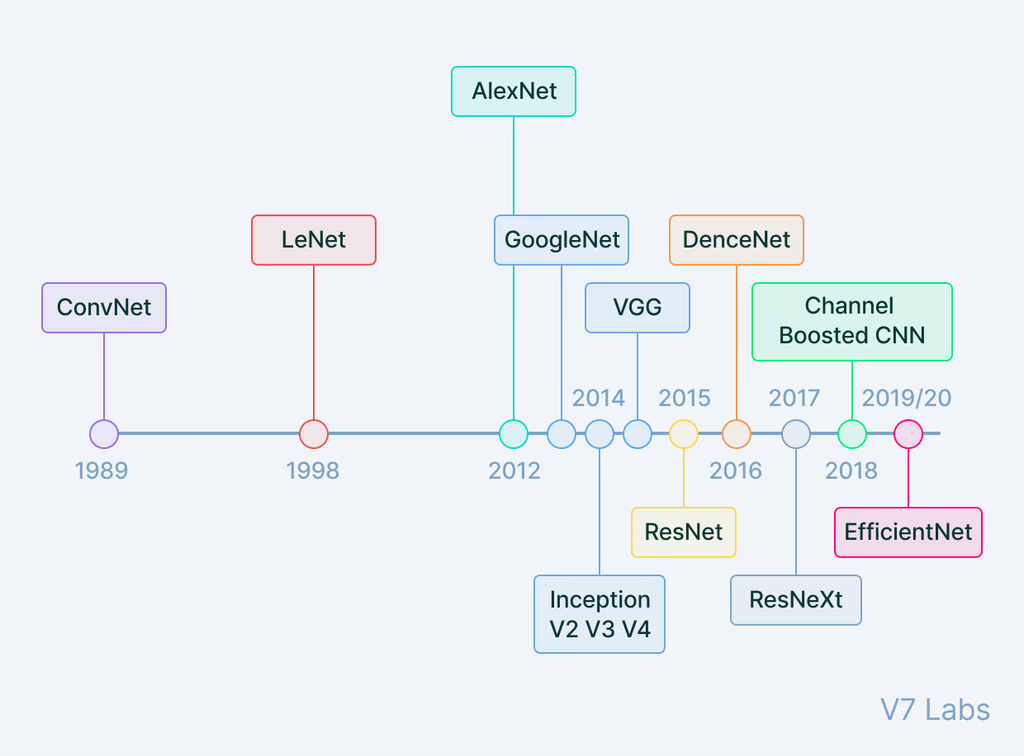
Table of Contents (ToC)
Introduction
A Convolutional Neural Network (CNN) is a deep learning model particularly effective for image and spatial data processing.
What's a Convolutional Neural Network (CNN)?
- A type of deep neural network designed to process structured grid data such as images.
- Utilizes convolutional layers to automatically detect spatial hierarchies in data.
- Primarily used in image recognition, object detection, and related fields.
Key Concepts and Terminology
- Convolutional Layer: Applies filters to input data to create feature maps.
- Pooling Layer: Reduces the spatial dimensions of feature maps, retaining essential information.
- ReLU (Rectified Linear Unit): Activation function used to introduce non-linearity.
- Fully Connected Layer: Connects neurons from one layer to another, typically used before the output layer.
Applications
- Image Classification: Identifying objects or subjects in images.
- Object Detection: Locating and identifying objects within images.
- Facial Recognition: Matching faces in images to identities.
- Medical Imaging: Analyzing and diagnosing conditions from medical images (e.g., X-rays, MRIs).
Fundamentals
CNN Architecture Pipeline
- Input Layer: Accepts image data typically in 2D (height x width x channels).
- Convolutional Layer: Applies filters to detect features like edges, textures, and patterns.
- Activation Function (ReLU): Applies non-linearity after each convolution operation.
- Pooling Layer: Downsamples feature maps to reduce dimensionality and computation.
- Fully Connected Layer: Combines features for final classification or regression tasks.
- Output Layer: Provides the final predictions, often using softmax for classification.
How CNNs Work
- Convolution Operation: Uses filters (kernels) to slide over input data and compute dot products, generating feature maps.
- Feature Extraction: Early layers capture low-level features (edges), while deeper layers capture high-level features (shapes, objects).
- Pooling: Reduces spatial dimensions to keep computation efficient and to prevent overfitting.
- Flattening: Converts 2D feature maps into a 1D vector for input into fully connected layers.
- Classification/Regression: The final fully connected layers output predictions based on extracted features.
Types of CNN Architectures
- LeNet-5: Early CNN architecture used for digit recognition.
- AlexNet: Introduced deeper networks with more filters and layers, won the 2012 ImageNet competition.
- VGGNet: Uses very small (3x3) convolution filters but with a deep network architecture.
- ResNet (Residual Networks): Introduced skip connections to allow for very deep networks, solving the vanishing gradient problem.
- Inception Network (GoogLeNet): Combines convolutions of different sizes in parallel to capture varying spatial features.
Some Hands-On Examples
- Image Classification: Using CNNs to classify CIFAR-10 or MNIST datasets.
- Object Detection: Implementing YOLO or Faster R-CNN for detecting objects in images.
- Facial Recognition: Building a CNN model to recognize faces from a dataset.
- Medical Image Analysis: Applying CNNs to classify diseases in medical scans.
Tools & Frameworks
- TensorFlow: Popular framework for building and training CNN models.
- Keras: High-level API for easy implementation of CNNs, built on top of TensorFlow.
- PyTorch: Widely used for flexible CNN development with dynamic computation graphs.
- OpenCV: Library for image processing, often used alongside CNNs for pre-processing.
Hello World!
from tensorflow.keras import layers, models

# Build a simple CNN model
model = models.Sequential([
    layers.Conv2D(32, (3, 3), activation='relu', input_shape=(28, 28, 1)),
    layers.MaxPooling2D((2, 2)),
    layers.Conv2D(64, (3, 3), activation='relu'),
    layers.MaxPooling2D((2, 2)),
    layers.Flatten(),
    layers.Dense(64, activation='relu'),
    layers.Dense(10, activation='softmax')
])

# Example model summary
model.summary()
Lab: Zero to Hero Projects
- Digit Recognizer: Build a CNN to classify handwritten digits using the MNIST dataset.
- Dog vs Cat Classifier: Train a CNN to distinguish between images of dogs and cats.
- Real-Time Object Detection: Implement a CNN-based object detection system using YOLO.
- Medical Image Classification: Develop a CNN to diagnose diseases from X-ray images.
References
- LeCun, Y., et al. (1998). "Gradient-based learning applied to document recognition."
- Krizhevsky, A., Sutskever, I., & Hinton, G. E. (2012). "ImageNet Classification with Deep Convolutional Neural Networks."
- Simonyan, K., & Zisserman, A. (2014). "Very Deep Convolutional Networks for Large-Scale Image Recognition."
- He, K., et al. (2015). "Deep Residual Learning for Image Recognition."
-
Szegedy, C., et al. (2015). "Going Deeper with Convolutions."
-
CNNs: https://en.wikipedia.org/wiki/Convolutional_neural_network
- CNNs HF Course: https://huggingface.co/learn/computer-vision-course/unit2/cnns/introduction
- CNN Models: CNN Notes
- Lab: CNN Notebooks