Autonomous (AI) Agents - Notes

Table of Contents (ToC)
- Introduction
- Key Concepts
- Applications
- Architecture Pipeline
- Framework / Key Theories or Models
- How Autonomous Agents Work
- Methods, Types & Variations
- Self-Practice / Hands-On Examples
- Pitfalls & Challenges
- Feedback & Evaluation
- Tools, Libraries & Frameworks
- Hello World! (Practical Example)
- Advanced Exploration
- Zero to Hero Lab Projects
- Continuous Learning Strategy
- References
- Related Notes: AI Notes, Embodied-AI Notes, Robotics Notes,
Introduction
Autonomous agents are systems or software entities that perform tasks or make decisions independently, often in dynamic environments, without continuous human intervention.
Key Concepts
- Autonomy: The ability of an agent to operate independently without external control.
- Agent: A software entity that can perceive its environment, reason about it, and take actions to achieve its goals.
- Multi-agent Systems (MAS): Systems in which multiple agents interact and cooperate to achieve a collective objective.
Misconception: Autonomous agents are often confused with automation. While automation follows a predefined script, autonomous agents adapt and learn from their environment.
Applications
- Robotics: Autonomous robots like self-driving cars or drones navigate and make decisions without human control.
- Virtual Assistants: Software agents like Siri and Alexa can autonomously perform tasks and respond to user commands.
- Finance: Autonomous trading agents make real-time decisions in stock markets.
- Healthcare: Agents assist with diagnostic tools and optimize workflows in medical environments.
- Gaming: Non-player characters (NPCs) in video games act autonomously to create more immersive experiences.
Mastering autonomous agents is critical for the development of systems that can handle complex tasks in real-time, such as in robotics, finance, and AI-driven services.
Architecture Pipeline
flowchart LR
    subgraph AgenticAI
        direction RL
        subgraph Agent
            direction LR
            A[Perception]-->B[Decision Making]
            B-->C[Learning Algorithms]
            C-->D[Planning]
            D-->E[Action]
        end
        subgraph Environment
            direction TB
            F[Environment Interaction]
        end

        Environment--(s,r)-->A
        E--a-->Environment

        classDef fillin fill: #fff
        class Environment,Agent fillin

endFramework / Key Theories or Models
- Reactive Agents: These agents respond directly to stimuli in their environment, often using rule-based systems.
- Deliberative Agents: These agents maintain an internal model of the world and plan actions based on goals.
- Hybrid Agents: Combine reactive and deliberative approaches to create flexible agents.
- Reinforcement Learning (RL): Agents learn optimal actions through trial and error in a reward-based environment.
- Markov Decision Process (MDP): A mathematical model used for decision making in environments where outcomes are partly random.
These models are essential in creating agents that can learn, plan, and act effectively in dynamic environments.
How Autonomous Agents Work
- Sensing the Environment: Agents gather data from sensors or input streams.
- Processing Data: Data is analyzed, and the agent decides on actions using decision-making algorithms or models.
- Learning from Feedback: Through interactions with the environment, agents receive feedback, often in the form of rewards or penalties.
- Action Execution: The agent executes the chosen action, which changes the environment or the state of the system.
- Continuous Adaptation: The cycle repeats, allowing the agent to adapt and improve its decision-making over time.
Methods, Types & Variations
- Single-agent Systems: Focuses on one agent acting independently.
- Multi-agent Systems (MAS): Multiple agents collaborate or compete within an environment.
- Collaborative Agents: Work together to achieve common goals.
- Competitive Agents: Operate in adversarial settings, often found in game theory.
Example:
- Single-agent Autonomous Robot vs. Multi-agent Autonomous Fleet: A single robot navigates an environment based on sensor data, whereas a multi-agent fleet communicates and coordinates to achieve a shared goal like warehouse management.
Self-Practice / Hands-On Examples
- Basic Exercise: Create a simple autonomous agent that navigates a maze using decision-making algorithms.
- Intermediate Exercise: Develop an agent using reinforcement learning that learns to play a simple game like Tic-Tac-Toe.
- Advanced Experimentation: Build a multi-agent system where agents compete or cooperate to achieve goals in a simulated environment (e.g., traffic management).
Pitfalls & Challenges
- Complexity of Environments: Dynamic or unpredictable environments require more sophisticated learning and decision-making models.
- Coordination in Multi-agent Systems: Ensuring agents in MAS can communicate and collaborate effectively can be a challenge.
- Computational Cost: Learning and adaptation processes, especially in real-time environments, can require significant computational resources.
Feedback & Evaluation
- Feynman Technique: Explain how autonomous agents work to a non-expert.
- Peer Review: Share your agent's decision-making process and get feedback on the effectiveness.
- Real-world Simulation: Test your agent in a simulated environment (e.g., in a game or robot simulator) and analyze its performance.
AI Agents Stack
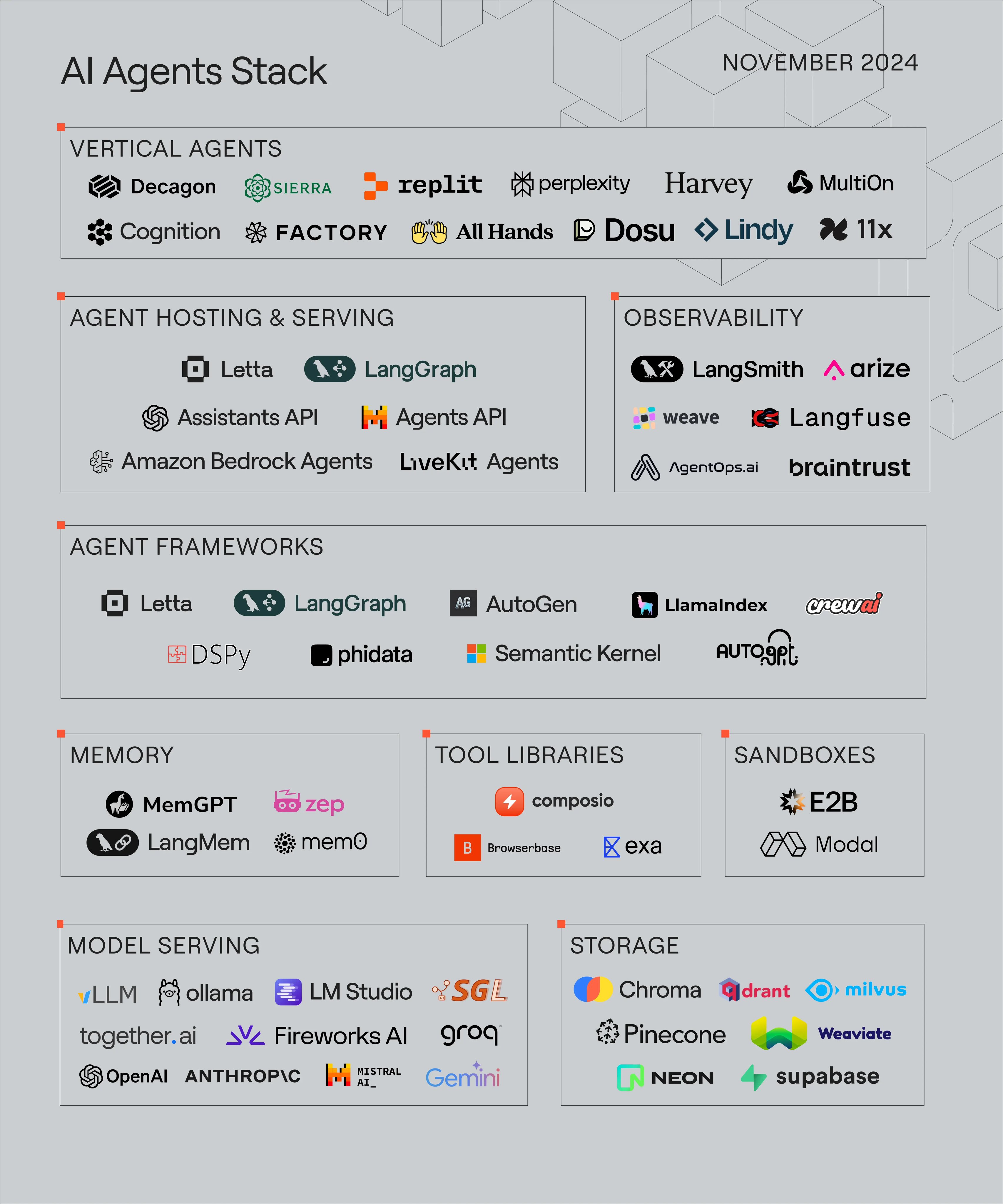
( Src: AgentOps)
Tools, Libraries & Frameworks
- Gym: A toolkit for developing and comparing reinforcement learning algorithms.
- ROS (Robot Operating System): A framework for robot development, commonly used for building autonomous agents in robotics.
- TensorFlow Agents: A library for building reinforcement learning agents using TensorFlow.
- JADE: A Java-based platform for developing multi-agent systems.
- crewAI
- Cradle
Comparison:
- Gym: Great for developing RL agents with easy access to environments, but not specific to robotics.
- ROS: Specifically designed for robotic systems but requires knowledge of hardware interaction.
- JADE: Ideal for multi-agent system simulations, but lacks machine learning tools like Gym or TensorFlow.
Hello World! (Practical Example)
import gym

# Create an environment (e.g., a cart-pole balancing task)
env = gym.make('CartPole-v1')

# Reset the environment
state = env.reset()

# Basic loop for agent-environment interaction
for _ in range(1000):
    env.render()  # Visualize environment
    action = env.action_space.sample()  # Take random action
    next_state, reward, done, info = env.step(action)  # Execute action
    if done:
        state = env.reset()

env.close()
Advanced Exploration
- "Autonomous Agents and Multi-Agent Systems" (Book)
- "Reinforcement Learning: An Introduction" by Sutton and Barto (Paper)
- AI Agents in Games and Simulations (Article)
Zero to Hero Lab Projects
- Beginner: Create a simple autonomous agent that solves a maze using rule-based logic.
- Intermediate: Implement a reinforcement learning agent to play a classic video game like Pong.
- Expert: Develop a multi-agent system where agents collaborate to optimize traffic flow in a smart city simulation.
Continuous Learning Strategy
- Deep Dive into Reinforcement Learning: Study advanced RL algorithms like Deep Q-Networks (DQN) or Proximal Policy Optimization (PPO).
- Explore Applications in Robotics: Learn how autonomous agents are being used in real-world robotics applications like drones or autonomous vehicles.
- Participate in Competitions: Try entering agent-based competitions like OpenAI’s Gym Challenges or Kaggle RL contests.
References
Wikipedia insights: - Intelligent Agent - Embodied Agent
- Book: "Autonomous Agents: From Self-Control to Autonomy" by Daniel G. Amen
- Website: OpenAI Gym Documentation (gym.openai.com)
- Research Paper: "A Survey of Multi-Agent Systems" by IEEE
- Intelligent Robotics and Autonomous Agents series - MIT
Lecture & Crash-courses: - Multi AI Agent Systems with crewAI Instructors by João Moura from crewAI
AI Leading Companies envision the future of Agentic AI (2024): - Langchain: https://www.langchain.com/stateofaiagents - Groq: https://groq.com/wp-content/uploads/2024/08/GroqThoughts_Agentic_VF_21Aug2024.pdf - artificiality: https://www.artificiality.world/content/files/2024/05/Agentic-AI.pdf