Generative AI - Notes
Table of Contents (ToC)
Introduction
Generative AI is a subset of artificial intelligence that focuses on creating new content based on existing data.
What's Generative AI?
- A field of AI that generates text, images, audio, and other content.
- Uses algorithms to produce new data similar to training data.
- Commonly employs neural networks, especially GANs and VAEs.
Key Concepts and Terminology
- GANs (Generative Adversarial Networks): Two neural networks contesting with each other to improve output.
- VAEs (Variational Autoencoders): Encodes data to latent space and decodes to generate new data.
- Latent Space: Abstract representation used by generative models to produce variations.
- Training Data: The dataset used to train generative models.
Applications
- Art and Design: Generating paintings, music, and other artistic works.
- Content Creation: Automated text, video generation, and virtual environments.
- Healthcare: Drug discovery, creating synthetic medical data for research.
- Gaming: Procedural generation of game levels, characters, and narratives.
Fundamentals
Generative AI Architecture Pipeline
graph LR
    A[Data Collection] --> B[Data Preprocessing]
    B --> C[Model Training]
    C --> D[Model Evaluation]
    D --> E[Content Generation]
How Generative AI works?
- Data Collection: Gathering relevant data sets for training.
- Data Preprocessing: Cleaning and preparing data for model training.
- Model Training: Using algorithms like GANs and VAEs to train models.
- Model Evaluation: Assessing model performance and refining as needed.
- Content Generation: Producing new data based on the trained model.
Types of Generative AI Models
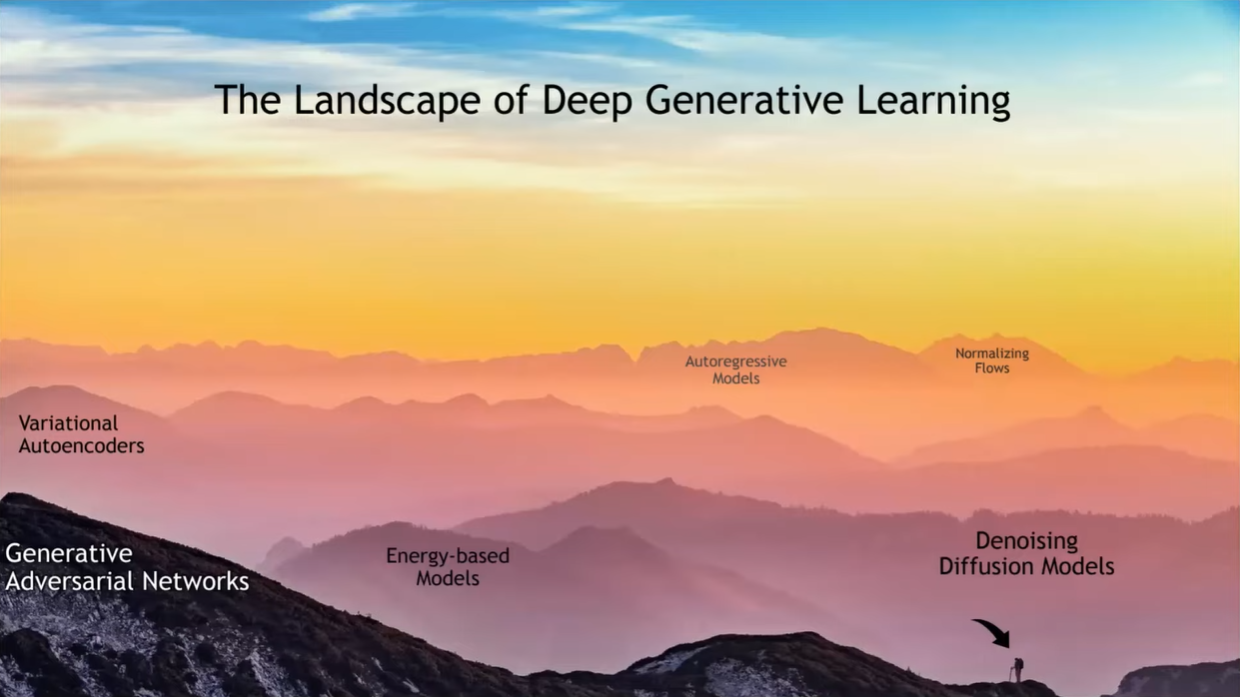
(Source: CS 198-126: Lecture 12 - Diffusion Models ML at Berkeley)
The table below provides a comprehensive overview of the various types of generative AI models, their techniques, descriptions, and application examples/interests.
| Name | Techniques | Description | Application examples/interests |
|---|---|---|---|
| GANs (Generative Adversarial Networks) | Two neural networks (generator and discriminator) contesting with each other | Used for generating realistic images, videos, and more by having a generator create data and a discriminator evaluate it | Image generation, video synthesis, data augmentation |
| VAEs (Variational Autoencoders) | Encodes input data into a probabilistic latent space and decodes it to generate new data | Generates new data that is similar to input data by learning the distribution of the data | Image and data reconstruction, anomaly detection |
| Autoregressive Models | Predicts the next data point in a sequence based on previous points | Generates data sequentially by predicting the next element in a series | Text generation (e.g., GPT), speech synthesis |
| Flow-based Models | Uses invertible transformations to generate data | Models the data distribution directly and provides exact likelihood estimation | Image synthesis, density estimation |
| Diffusion Models | Models data generation as a gradual transformation process | Generates high-quality data by denoising a corrupted version of the data | High-quality image synthesis, video generation |
| Recurrent Neural Networks (RNNs) | Uses sequential data to learn temporal dependencies | Captures dependencies in sequential data such as time series or text | Language modeling, music composition, speech synthesis |
| LSTMs (Long Short-Term Memory Networks) | Type of RNN that can learn long-term dependencies | Overcomes the vanishing gradient problem in standard RNNs | Text generation, sequence prediction, time series forecasting |
| GRUs (Gated Recurrent Units) | Similar to LSTMs but with a simpler architecture | Efficiently captures dependencies in sequential data | Similar applications as LSTMs but often faster to train |
| Transformer Models | Uses self-attention mechanisms to process input data in parallel | Captures dependencies in data without regard to position | Text generation (e.g., BERT, GPT), translation, summarization |
| Energy-Based Models (EBMs) | Associates lower energy with correct data configurations | Learns the distribution of data by mapping it to an energy value | Image generation, unsupervised learning |
| PixelCNN/PixelRNN | Generates images one pixel at a time conditioned on previous pixels | Sequentially models image pixels to generate high-quality images | Image synthesis, inpainting |
| Neural ODEs (Ordinary Differential Equations) | Provides a continuous-time generative model approach | Uses differential equations to model the data generation process | High-resolution data generation, continuous-time modeling |
| Boltzmann Machines | Network of symmetrically connected nodes that learn to represent the probability distribution of a dataset | Captures complex dependencies in data by modeling energy-based probabilities | Feature learning, dimensionality reduction |
Some hands-on examples
- Text Generation: Using GPT-3 to create articles, stories.
- Image Generation: Using GANs to create realistic images from scratch.
- Music Generation: Training models to compose music in various styles.
Tools & Frameworks
- TensorFlow: Open-source library for machine learning and AI.
- PyTorch: Deep learning framework known for flexibility and ease of use.
- Keras: High-level neural networks API, running on top of TensorFlow.
- OpenAI GPT: A powerful tool for natural language processing and text generation.
Hello World!
import torch
from transformers import GPT2LMHeadModel, GPT2Tokenizer

# Load pre-trained model and tokenizer
model_name = 'gpt2'
model = GPT2LMHeadModel.from_pretrained(model_name)
tokenizer = GPT2Tokenizer.from_pretrained(model_name)

# Encode input text
input_text = "Once upon a time"
input_ids = tokenizer.encode(input_text, return_tensors='pt')

# Generate text
output = model.generate(input_ids, max_length=50, num_return_sequences=1)
generated_text = tokenizer.decode(output[0], skip_special_tokens=True)

print(generated_text)
Lab: Zero to Hero Projects
- Create a Text Generator: Build a model to generate coherent paragraphs.
- Generate Artwork: Use GANs to create original digital art.
- Compose Music: Develop a system to compose music in different genres.
- AI Chatbot: Construct a conversational agent using generative models.
References
Wikipedia: - Generative Artificial Intelligence - Large language model - Foundation models - Generative pre-trained transformer - Generative adversarial network (GAN)
OpenAI : - Generative Pre-trained Transformer (GPT) Models : - GPT models : https://platform.openai.com/docs/guides/gpt - GPT Best Practices - openai : https://platform.openai.com/docs/guides/gpt-best-practices - GPT Family Models : - GPT-1 : https://en.wikipedia.org/wiki/Generative_pre-trained_transformer - GPT-2 : https://en.wikipedia.org/wiki/GPT-2 - paper : https://arxiv.org/ftp/arxiv/papers/1908/1908.09203.pdf - GPT-3 : https://en.wikipedia.org/wiki/GPT-3 - paper : https://arxiv.org/pdf/2005.14165.pdf - GPT-4 : https://en.wikipedia.org/wiki/GPT-4 - paper : https://arxiv.org/pdf/2303.08774.pdf - Codex : - paper : https://arxiv.org/pdf/2107.03374.pdf - InstructGPT (ChatGPT ancestor) : - paper : https://arxiv.org/pdf/2203.02155.pdf
Google : - Generative AI on Vertex AI Documentation - Generative AI on Vertex AI Studio - Generative AI Search Engine - Google's T5 - Microsoft DialoGPT - Introduction to Generative AI - Google Cloud Tech
NVIDIA :
- https://www.nvidia.com/en-us/ai-data-science/generative-ai/
- Generative AI - Technical Blog: https://developer.nvidia.com/blog/category/generative-ai/
- https://www.nvidia.com/en-us/glossary/data-science/generative-ai/
- https://www.nvidia.com/en-us/ai-data-science/generative-ai/news/
- Nvidia Reveals Grace Hopper Generative AI Chip (Computex 2023) : https://www.youtube.com/watch?v=_SloSMr-gFI&t=5s
IBM - AI Essentials: - https://www.youtube.com/watch?v=9gGnTQTYNaE&list=PLOspHqNVtKADfxkuDuHduUkDExBpEt3DF
Oracle - What Is Generative AI? How Does It Work?
Lectures & Online course: - Lecture 13 | Generative Models - Fei-Fei Li & Justin Johnson & Serena Yeung - 2017 - Google: - Introduction to Generative AI Path - NEW: https://medium.com/@rajputgajanan50/master-ai-in-2024-with-these-8-free-google-courses-257d9982a3e0 - Google ML Education: https://developers.google.com/machine-learning - https://www.cloudskillsboost.google/catalog - https://opportunitiescorners.com/google-artificial-intelligence-course-2023/ - Google AI Essentials - Coursera
Business Insights: - What is generative ai
Papers and books:
- Goodfellow, I., Pouget-Abadie, J., Mirza, M., Xu, B., Warde-Farley, D., Ozair, S., ... & Bengio, Y. (2014). Generative adversarial nets. Advances in neural information processing systems, 27.
- Kingma, D. P., & Welling, M. (2013). Auto-encoding variational bayes. arXiv preprint arXiv:1312.6114.
- Radford, A., Wu, J., Child, R., Luan, D., Amodei, D., & Sutskever, I. (2019). Language models are unsupervised multitask learners. OpenAI.
- Chollet, F. (2017). Deep learning with Python. Manning Publications.